
Rare Beauty: When Vulnerability Became Structure
A cultural case study in emotional safety, legitimacy, and modern trust
Primary SEO: Rare Beauty brand strategy, Rare Beauty marketing strategy, Rare Beauty branding, Rare Beauty case study
Secondary SEO: mental health branding, vulnerable branding, celebrity-founded beauty brands, inclusive beauty marketing

Image Courtesy: The Independent
Introduction: Vulnerability Is Powerful — and That’s the Risk
Vulnerability has become culturally desirable.
It signals authenticity.
It invites connection.
It softens authority.
And because of that, it is easily exploited.
Most brands speak the language of vulnerability without assuming its responsibility. They reveal stories, surface emotion, and invite intimacy — while structurally extracting attention, labor, and trust in return.
Rare Beauty understood something more difficult:
Vulnerability is not safe by default. It becomes safe only when restraint is built around it.
This Rare Beauty case study examines how the brand transformed vulnerability from narrative exposure into system design — and why that distinction is the difference between care and commodification.
Visibility Without Safety Is Not Progress
By the time Rare Beauty launched, the beauty industry had already absorbed the vocabulary of self-love.
Authenticity was encouraged.
Mental health was acknowledged.
Exposure was normalized.
But structurally, little had changed.
Consumers were still asked to perform confidence in environments optimized for comparison. Emotional openness increased — while protection did not.
Anthropologically, this produced a bind:
express more
self-monitor harder
absorb judgment quietly
Most brands responded with reassurance.
Rare Beauty responded with containment.
Selena Gomez and the Cost of Being Seen
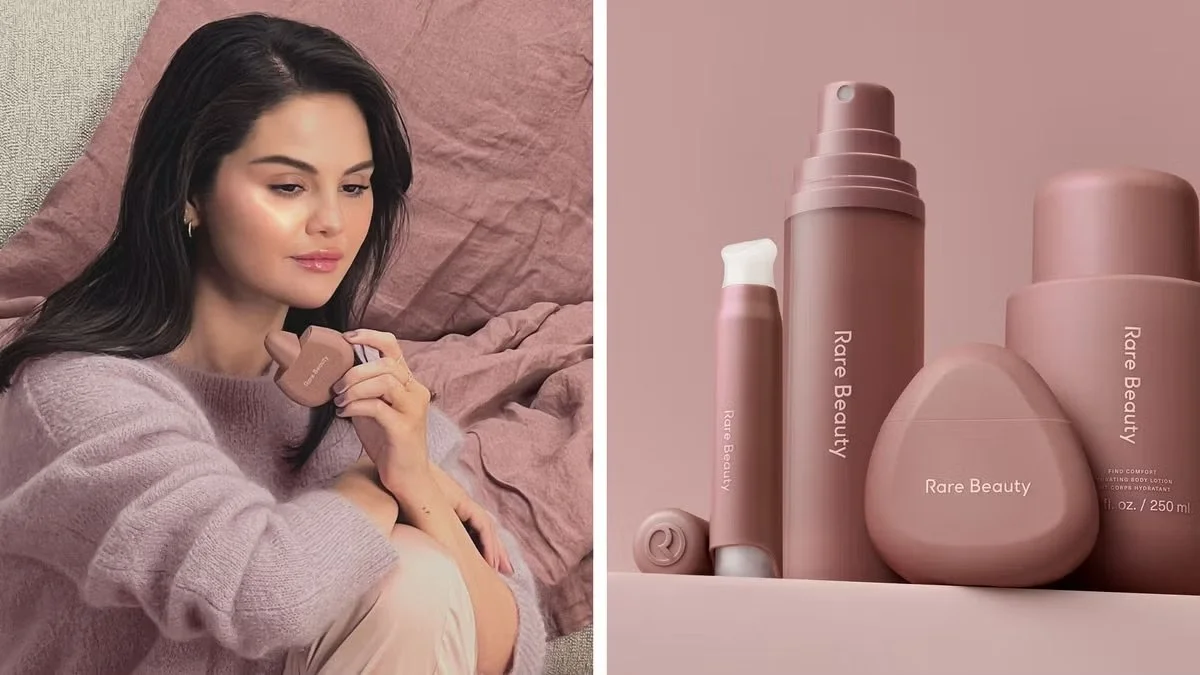
Image Courtesy: The Independent
Selena Gomez’s presence in Rare Beauty is often framed as relatability. This framing underestimates the role she plays.
Selena’s public life has been shaped not by ascent alone, but by interruption — illness, withdrawal, and visible vulnerability under constant observation. She represents not success despite exposure, but damage caused by it.
This matters.
Rare Beauty does not borrow Selena’s visibility to humanize the brand. It borrows her knowledge of exposure’s limits.
That produces a different kind of credibility — one rooted in caution rather than optimism.
Products That Lower the Stakes of Self-Expression
Rare Beauty’s products are engineered to forgive.
Blendable formulas.
Diffused pigment.
Textures that soften rather than sharpen.
This is not an aesthetic decision. It is a psychological one.
Behaviorally, forgiving tools reduce self-surveillance. They remove the penalty for imperfection. They allow participation without precision.
Where traditional beauty products heighten performance pressure, Rare Beauty lowers it.
The product quietly says:
You don’t have to get this right to belong here.
Design That Resists Domination
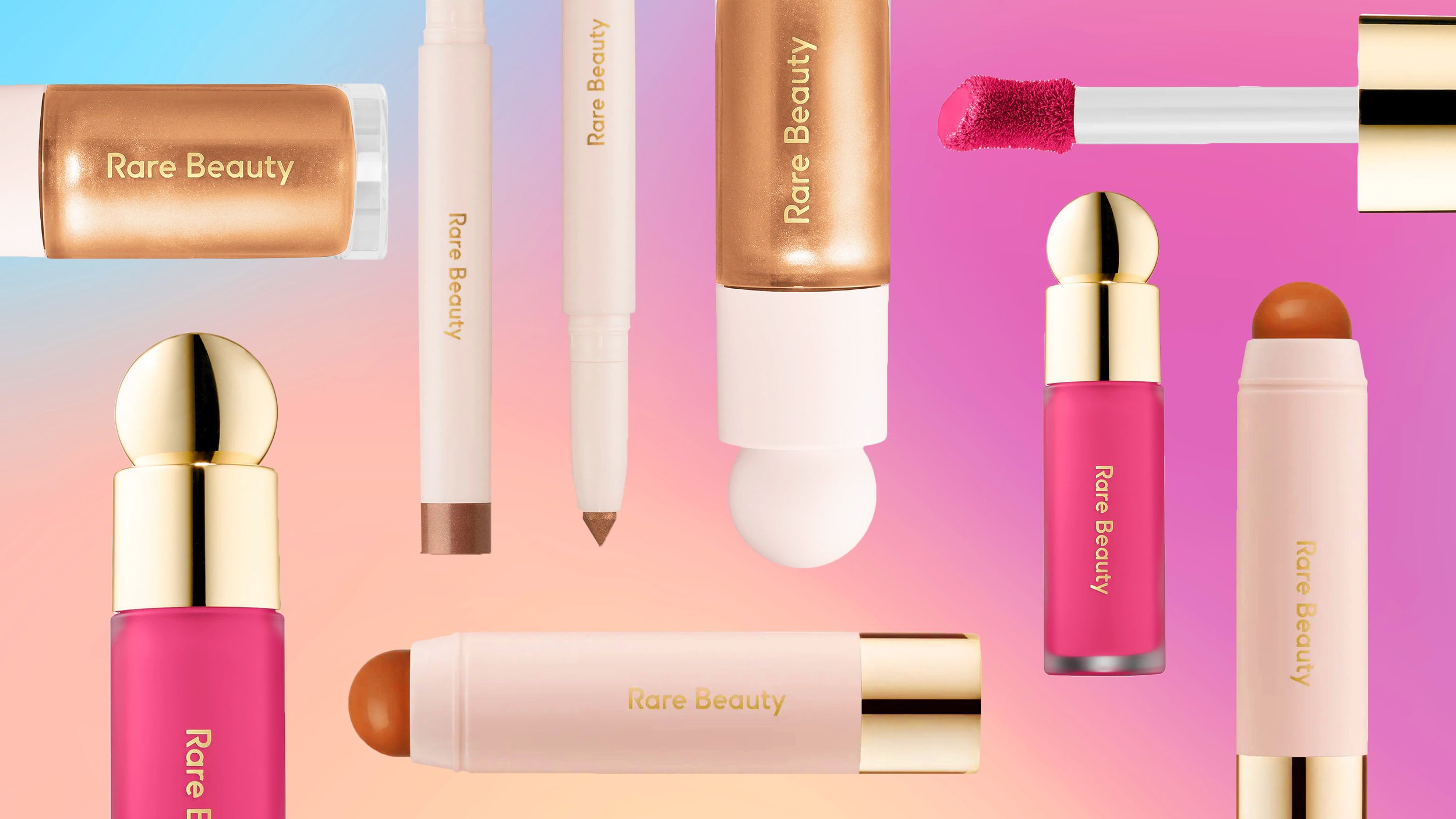
Image Courtesy: Marie Claire
Rare Beauty’s visual language is intentionally unassertive.
Rounded forms.
Soft finishes.
Weight that feels steady, not imposing.
These choices resist dominance cues common in prestige beauty. They do not demand admiration or mastery. They communicate approachability without infantilization.
Even functional accessibility — easier-open packaging, ergonomic considerations — reinforces the same principle:
The brand adapts to the human.
The human is not asked to adapt.
This is design not as expression, but as emotional buffering.
Mental Health as Obligation, Not Identity
Many brands speak about mental health. Few bind themselves to it.
Rare Beauty’s Rare Impact Fund does more than donate proceeds. It structurally ties brand growth to mental health support — removing optionality.
This matters because vulnerability collapses when it is contingent.
When support depends on performance, mood, or optics, it ceases to be safe. By embedding responsibility at the economic level, Rare Beauty transforms care from brand identity into institutional constraint.
The brand limits itself — and that limitation is what makes it trustworthy.
Growth Conducted Under Emotional Ethics
Rare Beauty avoided acceleration tactics that often accompany emotional positioning.
No urgency-driven launches.
No emotional escalation.
No dramatized scarcity.
This restraint is strategic.
Vulnerability paired with urgency becomes coercive. Emotional intimacy combined with speed exploits trust before it can stabilize.
Rare Beauty grew slowly enough to preserve credibility — protecting the emotional contract it created with its audience.
Strategic Implications for Brand Builders
Rare Beauty reveals a difficult truth:
Vulnerability is not inherently ethical
Emotional openness increases responsibility, not goodwill
Safety must be designed, not declared
Credibility comes from limits, not disclosure
Trust is built when brands refuse to extract
Rare Beauty succeeds because it resists doing too much with the emotion it invites.
Conclusion: The Discipline of Gentle Brands
Rare Beauty’s achievement is not kindness.
It is discipline.
The discipline to slow growth.
To soften tools.
To reduce pressure.
To build guardrails where exposure is unavoidable.
In a culture that rewards emotional revelation but rarely safeguards it, Rare Beauty offers something structurally rare:
a brand that makes space for being seen — without demanding that visibility be productive.
That restraint is not weakness.
It is care, made systemic.
Essential Reads: Understanding Rare Beauty’s Emotional Architecture
1. Holding Environment — D.W. Winnicott
Why: Frames how psychological safety is created through structure — foundational to understanding Rare Beauty’s approach.
2. The Managed Heart — Arlie Hochschild
Why: Explains emotional labor and why brands must avoid extracting it from consumers under the guise of care.
3. Daring Greatly — Brené Brown
Why: Explores vulnerability as a condition for trust and connection—essential to understanding why Rare Beauty’s emotionally protective structure feels credible rather than performative
4. Designing for Emotion — Aarron Walter
Why: Connects product and design decisions to emotional response without manipulation.
5. Brand Seduction — Daryl Weber
Why : Explains how calm, safety, and consistency build non-conscious trust.
