
Olipop: How Nostalgia Became Trust in Modern Wellness Branding
A cultural case study in reassurance, memory, and emotional credibility
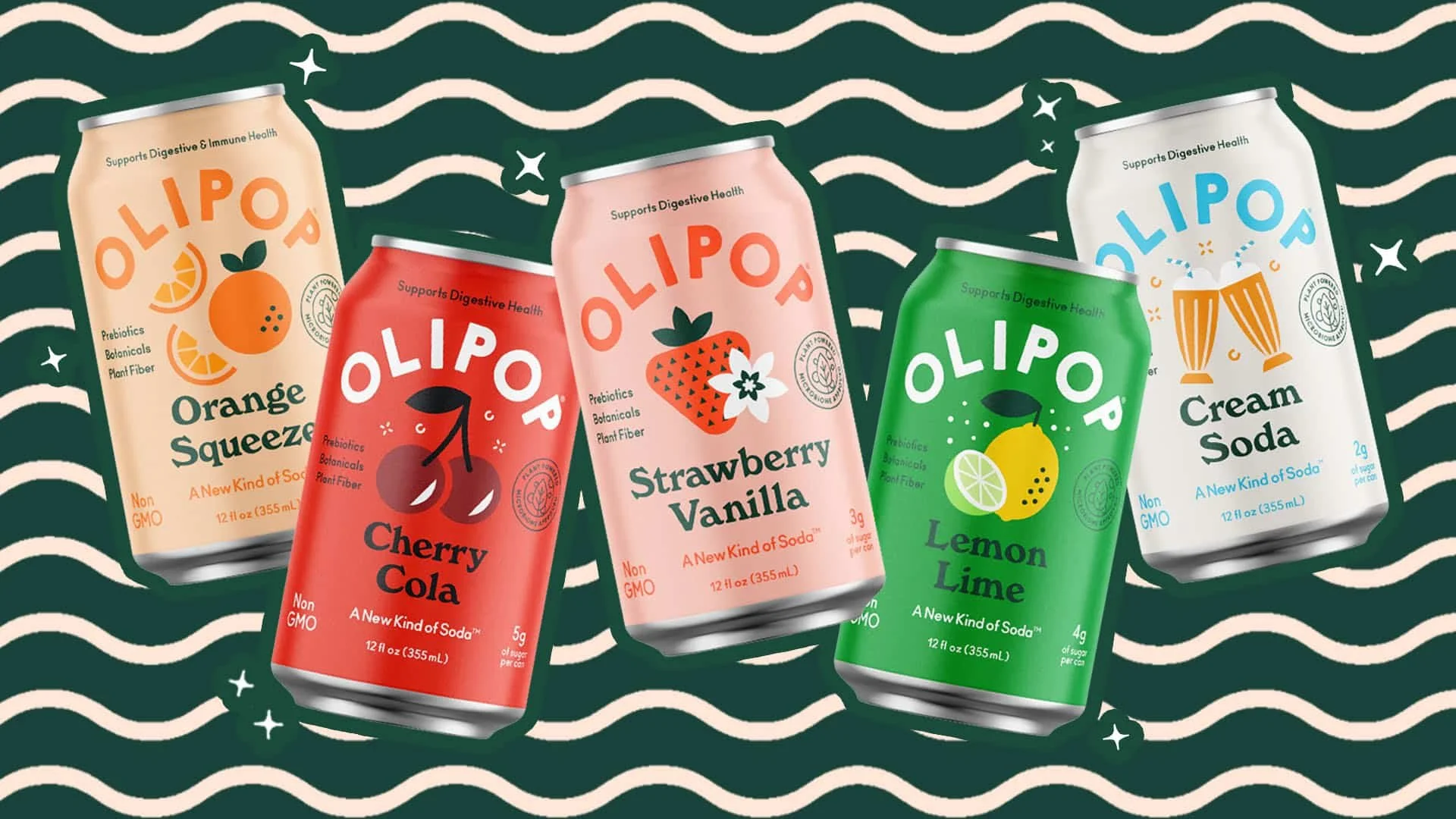
Image Courtesy: Sporked
Introduction: When Wellness Needed Stability, Not More Innovation
By the time Olipop entered the wellness beverage space, health culture was not lacking solutions. It was lacking confidence.
Consumers had grown accustomed to novelty—new ingredients, new claims, new identities—but that abundance created friction. Functional beverages multiplied, yet trust eroded. Health felt increasingly experimental, provisional, and psychologically demanding.
Olipop did not attempt to invigorate wellness with novelty.
It steadied it with familiarity.
This Olipop case study explores how the brand succeeded not by reinventing soda, but by restoring emotional credibility to a category that had lost it. Where many wellness brands chased transformation, Olipop offered something quieter—and ultimately more stabilizing: reassurance.
Repairing a Category, Not Disrupting It
Soda once represented ubiquity. Shared meals. Reliable pleasure. Over time, it became symbolically burdened—linked to excess and irresponsibility—while health beverages moved in the opposite direction, growing complex and morally charged.
Olipop’s brand strategy addressed a deeper cultural problem: soda no longer felt trustworthy, and wellness no longer felt grounded.
Instead of rejecting soda culture outright, Olipop reframed its role. Soda didn’t need to be replaced; it needed to be repaired. The brand presented itself as a functional soda that preserved what soda once offered emotionally—familiarity, continuity, presence—while quietly updating its physiological profile.
Anthropologically, this matters because cultures gravitate toward what feels stable in times of overload. Olipop succeeded by positioning itself not as progress, but as restoration.
Origin as Emotional Legitimacy
Olipop’s founding story centers on digestive health, but its deeper resonance lies in its philosophical restraint. Founders Ben Goodwin and David Khang focused not only on formulation, but on experience continuity—the texture, taste, and rituals consumers already understood.
Rather than dramatizing disruption, Olipop pursued legitimacy through recognizability.
This is a subtle but powerful distinction in branding psychology. Trust is rarely built through intensity. It is built when innovation does not demand emotional reorientation.
Olipop honored the past without romanticizing it. In doing so, it gave consumers permission to reengage with soda without having to renegotiate their values.
Nostalgia as Psychological Infrastructure
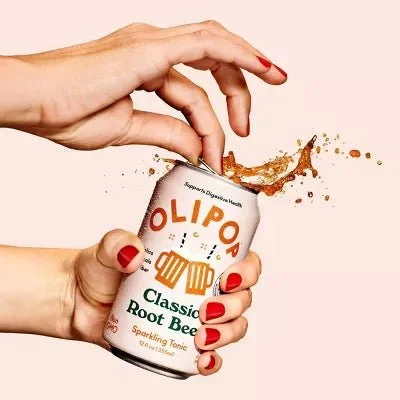
Image Courtesy: Mundane Magazine
Olipop’s soda branding is often described as retro. Psychologically, it functions as something more foundational.
Nostalgia operates as a stability cue. It lowers uncertainty, softens skepticism, and signals emotional safety. In contexts where consumers feel fatigued by constant newness, nostalgic cues act as reassurance—this will not ask too much of you.
Olipop’s classic flavor names, vintage typography, and heritage-inspired layouts reactivated emotional memory without encouraging excess. This allowed the brand to introduce functional claims—fiber, prebiotics—without activating resistance.
The past, here, became scaffolding for trust.
Design as Evidence, Not Expression
The re-brand that drove $500M success
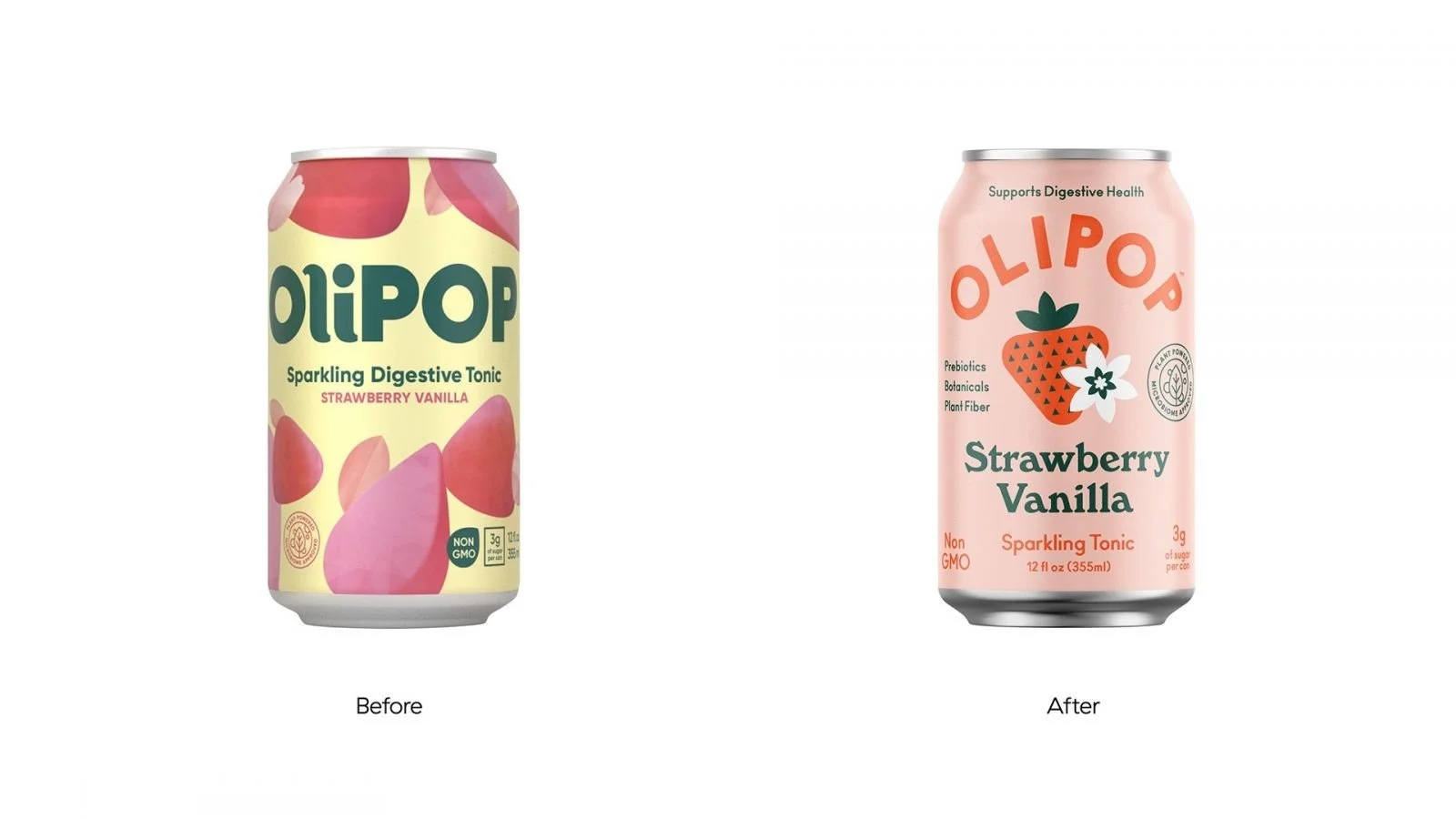
Olipop’s can design reflects a deeper cultural and psychological shift in how the brand positions itself. Earlier expressions leaned more heavily on function—signaling digestive benefit and wellness utility in ways that required explanation. Over time, the visual language moved away from the logic of a “sparkling digestive tonic” and toward something quieter and more assured.
This evolution matters. As Olipop gained cultural traction, it no longer needed to justify its function at the point of purchase. Instead, the can began doing subtler work: placing the brand firmly within the mental category of everyday soda, without relinquishing its functional credibility. The design does not announce health. It assumes trust.
Anthropologically, packaging is often the first site of belief. Before ingredients are read or benefits evaluated, consumers make a rapid, subconscious judgment about whether something belongs. Olipop’s can no longer asks to be interpreted or decoded. It asks to be accepted.
Its restraint—balanced hierarchy, familiar proportions, deliberate composure—signals stability rather than novelty. In a market crowded with visual urgency, Olipop chose calm. This was not an aesthetic decision so much as a psychological one. The can does not perform wellness. It normalizes it.
In moving from explanation to composure, Olipop used design not as expression, but as evidence: evidence that the brand understands where it sits, what role it plays, and how little it now needs to prove.
Functional Benefits Without Emotional Escalation
In prebiotic soda marketing, balance is rare. Many brands overwhelm consumers with science or bury benefit under lifestyle imagery.
Olipop maintains credibility through moderation.
Its health claims are present but secondary, clear but uninsistent. This lowers cognitive friction while maintaining trust—an essential balance when reassurance is the primary emotional job.
Importantly, Olipop does not frame health as self-improvement. It frames it as maintenance. A way to continue enjoying what already exists, without consequence.
A Note on Positioning: Two Functional Sodas, Two Emotional Jobs
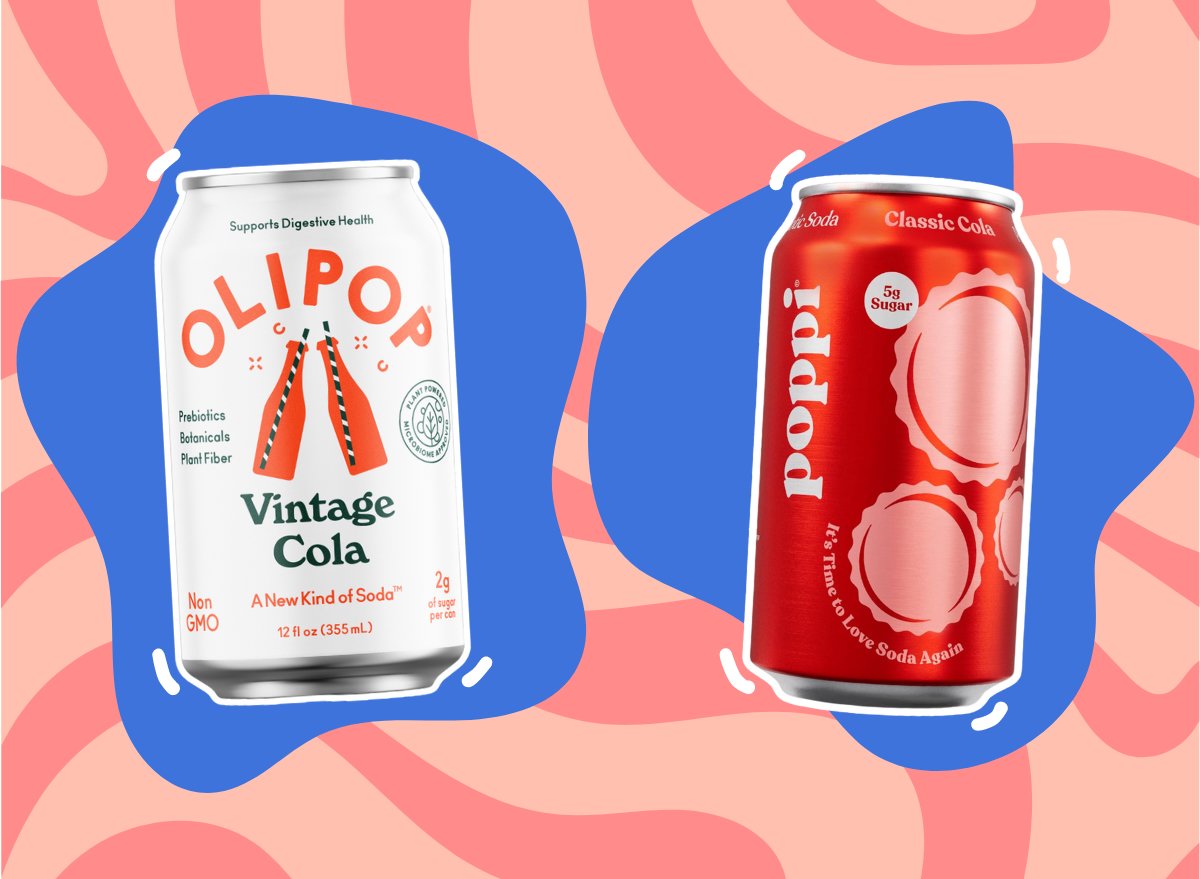
Image Courtesy: Eat This Not That
Both Olipop and Poppi occupy the same product category—functional, low-sugar soda. Yet their cultural success illustrates a crucial branding truth: consumers are not choosing between formulations. They are choosing between emotional resolutions.
Olipop operates through familiarity and reassurance. Its branding draws on memory, continuity, and trust—making soda feel dependable again.
Poppi, by contrast, works through lightness and release. Its visual language and tone reduce emotional pressure, reframing wellness as playful rather than corrective.
Neither approach is superior. Each responds to a different psychological fatigue within contemporary wellness culture.
What matters is not the category itself, but the emotional work the brand performs.
Strategic Takeaways for Brand Builders
Olipop’s marketing strategy offers several enduring insights:
Reassurance can outperform reinvention in saturated categories
Nostalgia, when used deliberately, functions as psychological safety
Continuity lowers resistance to adoption
Design can signal trust as powerfully as it signals differentiation
Emotional memory is a competitive asset in wellness branding
Olipop didn’t compete on excitement.
It competed on stability.
Conclusion: Olipop and the Return of Emotional Reliability
Olipop reveals a quiet truth about modern branding.
When categories become crowded and belief becomes fragile, the brands that thrive are not those that shout louder—but those that steady the field.
Olipop modernized soda not by distancing itself from the past, but by reconciling with it.
In doing so, it demonstrated that trust is built not through acceleration, but through emotional grounding.
Top 5 Essential Reads to Deepen This Olipop Case Study
1. The Nostalgia Factory — Douwe Draaisma
Why it matters: Explores how memory influences emotional decision-making and why familiarity reduces uncertainty.
2. Alchemy — Rory Sutherland
Why it matters: Explains why perceived reassurance often outperforms objective improvement.
3. How Brands Grow – Part 2 — Byron Sharp
Why it matters: Olipop’s distinctive yet familiar assets build mental availability without relying on novelty.
4. Primal Branding — Patrick Hanlon
Why it matters: Olipop’s icons, rituals, and creation story reinforce belief through continuity.
5. The Experience Economy — Pine & Gilmore
Why it matters: Olipop preserves a familiar consumption experience while quietly upgrading its value.
